
By LISSA STROHECKER
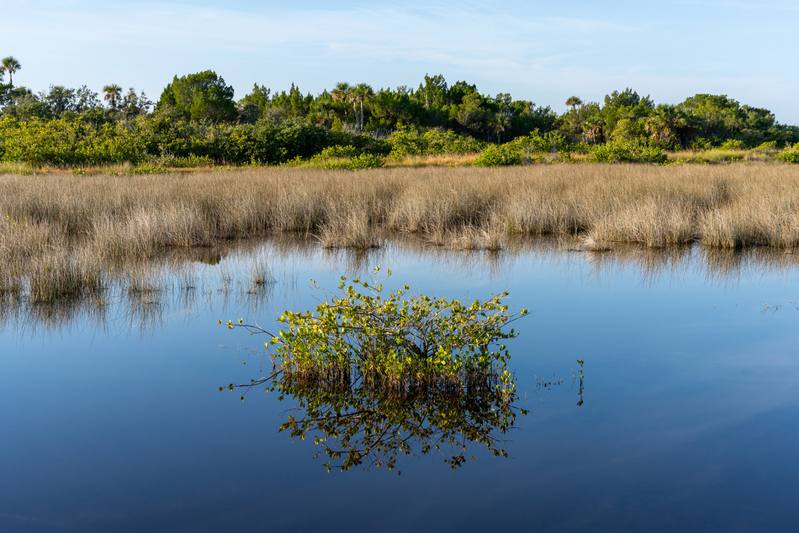
After decades of restoring coastal wetlands, Ron Brockmeyer thought he knew what a project in Merritt Island would cost. He was wrong, in a good way.
Brockmeyer has spent the last 30 years with the St. Johns River Water Management District (District), partnering with local governments to return man-made dikes, ditches and spoil piles to fully functional coastal wetlands. So, when he began planning a 2025 project to grade 15 miles of dike in Merritt Island, he felt confident in his cost estimates. Experience from many past projects, along with changes in fuel and labor costs, informed the budget. He secured the funding and, with District Operations and Maintenance support, hired contractors and work began.
Restoring wetlands is both a science and an art, and every site is unique. To restore a coastal wetland, the surface elevation must be reconnected to the natural tidal cycle. Because tidal cycles vary from place to place, determining the correct elevation is one of the most important steps in restoration.
Plants provide clues about local tides. For example, black mangroves growing along the shoreline and in the shallow water near the restoration site help determine the target elevation. Black mangroves have a unique adaptation that allows them to grow in oxygen-deprived soils and with submerged roots. Specialized root structures called pneumatophores act like snorkels, growing just above the water to allow gas exchange in the mangroves’ roots.
Since pneumatophores grow just above the highest seasonal tide, Brockmeyer can measure the height of the pneumatophores to identify the appropriate elevation needed to restore wetland function. Once the target elevation is established, excavators and bulldozers grade piles of dredge spoil, ditches and dikes to the appropriate height.
In the Indian River Lagoon, where the Merritt Island project would take place, the difference between high and low tide is measured in centimeters. The grading must be precise.
“Historically, after the first pass, contractors would survey the surface elevation, then the bulldozer would make another pass, then crews would re-survey the site until the soil was exactly the right height,” Brockmeyer said.
For Brockmeyer’s most recent project, contractors used GPS-based instrumentation mounted directly on their bulldozer blades. Standard GPS, such as what is used in a cell phone, is accurate to within a foot or so, but specialized systems used on these projects rely on local base stations that broadcast precise, real-time elevation information to the bulldozers. The blades became accurate to within centimeters. It’s a game-changer for earthwork efficiency.
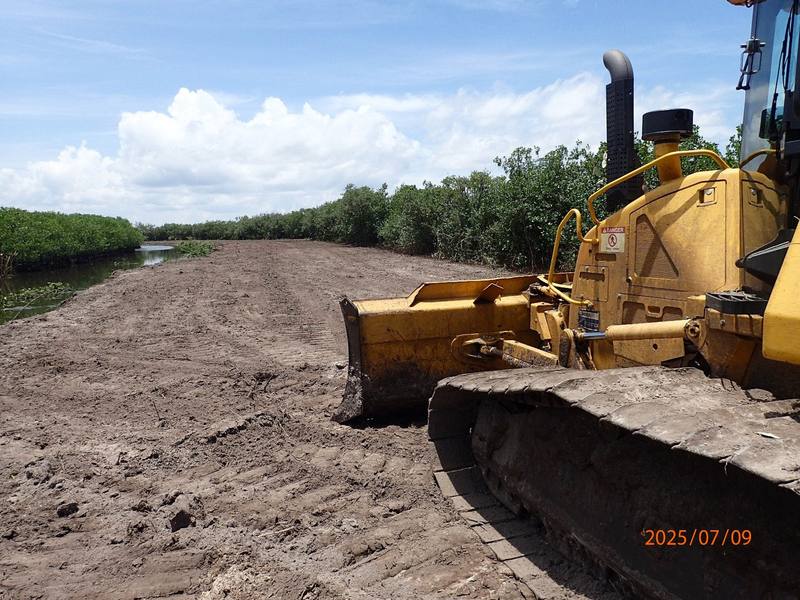
Operators could set the target elevation and reach the required specifications within just a few passes. With less back-and-forth grading and surveying, labor costs declined and the project progressed faster.
“Some days I couldn’t believe how much work they would get done,” said Brockmeyer. The increased efficiency meant dramatic cost savings. “The cost was less than one-third of what we had budgeted for the project. Technology improvements have lowered the cost of restoring coastal wetland habitat dramatically.”
In 2010, the cost to restore a wetland by grading a dike around an impounded area worked out to roughly $10.50 per linear foot of dike. For the 2025 restoration, Brockmeyer estimated the project would cost roughly $20 per foot based on traditional approaches and current costs. Thanks to the integration of precision GPS, the final cost worked out to $6.70 per linear foot.
The increased efficiency only improves the return on investment gained through coastal wetland restoration. These ecosystems are incredibly important in terms of flood protection, fisheries and improved water quality. These benefits are among the reasons Brockmeyer has spent decades implementing coastal restoration projects.
When storms hit, a coastal wetland can absorb floodwater and dampen wave energy, lessening erosion along coastlines and protecting communities from flooding. Wetland plants, from mangroves to cord grasses, filter out sediment and pollutants while oysters consume algae, leading to improvements in water quality.
Functioning coastal wetlands are also adaptable. Wetlands migrate inland and rise in elevation, accumulating sediment as sea level rises, supporting resilience for future generations. Coastal wetlands are among the most effective natural systems for removing and storing carbon from the atmosphere.
A 2007 study estimated the value of coastal wetlands in terms of ecosystem benefits. Adjusting for 2026 dollars, a functional coastal wetland provides about $126,000 of benefit per acre each year.
The 2025 project yielded 85 acres of restored wetland surface for a cost of roughly $6,000 per acre. In addition, these projects require no ongoing operation or maintenance. Wetland plants quickly colonize the regraded areas on their own and begin providing benefits.
The cost savings on the Merritt Island restoration means more than coming in under budget. With funding remaining, Brockmeyer said he plans to complete additional restoration projects along the northeast Florida coastline. As technology continues to improve and restoration becomes more efficient, he said he hopes more coastal wetlands can be restored, delivering benefits for decades to come.
To learn more about the District’s coastal restoration efforts, visit the St. Johns River Water Management District website.
Lissa Strohecker is Regional Media and Communications Coordinator at the St. Johns River Water Management District