
By STAFF REPORTS
Appeals Court Vacates Injunction Behind Brevard Septic Moratorium
The U.S. Court of Appeals for the Eleventh Circuit on October 8 vacated the judgment and injunction in Bear Warriors United v. Florida Department of Environmental Protection, creating a path toward lifting the court-imposed septic moratorium affecting Brevard County.
The lawsuit alleged that DEP’s wastewater regulatory program damaged manatee habitat in the North Indian River Lagoon in violation of the Endangered Species Act. The district court’s decision relied on a federal definition of “harm” that included habitat degradation causing actual injury or death to wildlife. That definition was rescinded while the appeal was pending.
The appeals court returned the case to the district court to evaluate the effect of the regulatory change. The ruling sets aside the existing injunction but leaves the lawsuit unresolved.
SWFWMD Expands Conservation Lands Within the Lower Peace River Corridor Project
The Southwest Florida Water Management District’s Governing Board recently approved a $7.5 million purchase of 1,270 acres within the Lower Peace River Corridor Project. The newly acquired properties include the C&D Ranch and Rock Bend Ranch conservation easements.
Funding is being provided through the Florida Forever Trust Fund. The acquisitions will help protect existing ecosystems, improve water quality flowing into the Charlotte Harbor estuary and safeguard regional water resources. The properties are located within the Florida Wildlife Corridor and are within two miles of other District and state conservation lands.
The easements span the lower basin of the Peace River and will provide four miles of frontage along the west side of the Peace River in DeSoto and Hardee counties while incorporating surrounding tributaries, connected headwaters, and floodplain swamps.
The 623.66-acre C&D Ranch conservation easement consists of approximately 48 percent wetlands and 52 percent uplands. C&D Ranch is situated in the Peace River Valley, which leads to Charlotte Harbor estuary and protects 1.9 miles of river frontage on the Peace River.
The 646.8-acre Rock Bend Ranch conservation easement is adjacent to C&D Ranch to the immediate south in DeSoto County and consists of approximately 60 percent wetlands and 40 percent uplands. This property has approximately 2.2 miles of frontage along the west side of the Peace River.
FPL’s Storm Secure Underground Program Exceeds Milestones
Florida Power & Light Company (FPL) has improved regional resilience by completing 2,000 miles of overhead-to-underground neighborhood power line conversions through the company’s Storm Secure Underground Program. The conversion benefits more than 200,000 customers.
The Storm Secure Underground Program uses a data-driven approach to improving the resiliency of the electric grid and restoring power for customers after hurricanes and severe weather. FPL strategically selects communities for undergrounding based on metrics such as power outages during named storms, vegetation-related outages and other reliability metrics.
The program is designed to strengthen the electric grid, improve storm resilience and reduce restoration costs and outage durations associated with hurricanes and extreme weather events. FPL’s storm performance data shows that underground neighborhood lines have experienced fewer outages than overhead neighborhood lines during hurricanes.
“Reaching 2,000 miles of projects completed under the Storm Secure Underground Program is the result of true partnerships between FPL, our customers and the communities we serve,” said Michael Jarro, FPL vice president of Power Delivery. “We appreciate the patience and cooperation of customers while this work takes place in their neighborhoods.”
State Protects More Than 10,800 Acres Across Florida
Florida’s administration recently approved the conservation of more than 10,770 acres across Florida, including more than 2,700 acres within the Ocala-to-Osceola Wildlife Corridor. The action represents an investment of more than $72.6 million and the advancing of Florida Forever, the Rural and Family Lands Protection Program and the Ocala-to-Osceola Wildlife Corridor projects.
“Today’s approvals reflect our commitment to being good stewards of Florida’s land and making smart investments in conservation. The Florida Wildlife Corridor is an important part of that effort, and I’m proud that more than 4,500 acres of working agricultural land will be permanently protected through the Rural and Family Lands Protection Program,” said Agriculture Commissioner Wilton Simpson. “RFLPP is a proven, cost-effective way to keep productive farmland in private hands and ensure it remains available to grow the food Floridians depend on for generations to come.”
The projects include a 2,708-acre conservation easement within the Etoniah/Cross Florida Greenway Florida Forever Project within the Florida Wildlife Corridor in Putnam County and a 3,567-acre conservation easement within the Panther Glades Florida Forever Project within the Florida Wildlife Corridor in Hendry County.
Acquisition of permanent agricultural land conservation easements over more than 4,500 acres of working agricultural lands through the Florida Department of Agriculture and Consumer Services’ Rural and Family Lands Protection Program was also approved, including a permanent conservation easement over 1,034 acres of Limestone Creek Ranch, a working cattle ranch for more than 70 years that was formerly owned by Gov. Doyle E. Carlton.
OUC Receives Grant to Enhance Reliability and Long-Term Affordability
Audrey Robertson, Assistant Secretary for the Office of Critical Minerals and Energy Innovation with the U.S. Department of Energy, recently announced the selection of Orlando Utilities Commission for a $12.97 million Speed to Power through Accelerated Reconductoring and other Key Advanced Transmission Technology Upgrades grant. The grant will support a major transmission infrastructure project designed to enhance grid reliability and meet growing energy demand across Central Florida.
“This investment reflects OUC’s commitment to ensuring reliable, future-ready service for our customers,” said Orlando Alancastro, Vice President of Transmission for OUC. “We began working on this request more than two years ago under the Grid Resilience and Innovation Partnerships grants program, and we’re honored to receive DOE’s support on a project that strengthens energy resilience in Central Florida.”
The grant will facilitate the installation of a new 115kV transmission line connecting the Southwood Substation to the Turkey Lake Substation, a critical upgrade identified by OUC’s System Planning & Reliability Engineering Division. The project will provide essential capacity, increased reliability and additional transfer capabilities for OUC’s bulk electric system.
The new line will span three miles, constructed on new structures along an existing transmission corridor. The expansion will help ensure OUC can reliably support projected load growth and maintain system resilience during peak demand periods.
SWFWMD Scheduling Prescribed Fires for Hillsborough County
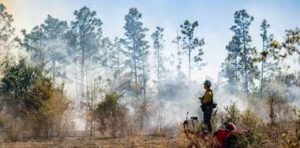
The Southwest Florida Water Management District will be conducting prescribed burns now through December on the Lower Hillsborough Wilderness Preserve. Prescribed fires in controlled settings can reduce the risk of wildfires burning out of control. The District conducts prescribed fires on approximately 35,000 acres each year.
The Lower Hillsborough Wilderness Preserve is located south of Cross Creek Boulevard between U.S. Highway 301 and Bruce B. Downs Boulevard near Thonotosassa. Approximately 300 acres will be burned in small, manageable units.
Benefits of prescribed fire include the reduction of overgrown plants decreasing the risk of catastrophic wildfires, promoting the growth of new, diverse plants, maintaining wildlife habitat and maintaining access for public recreation.
The public can sign up to receive email and/or text alerts about scheduled prescribed burns and learn more about the process of a prescribed burn by visiting WaterMatters.org/PrescribedBurns.
USF and TECO Advance Next-Generation Power Grid Intelligence
USF’s Linling Fan and Zhixin Miao are collaborating with Tampa Electric on a $3.8 million grant from the U.S. Department of Energy, to develop a digital twin — a virtual copy of the utility’s power system. Using real-time data from TECO facilities, the computer model continuously mirrors real-world grid conditions.
The research is anticipated to help stabilize grid operations while accommodating the growing stream of connections by alternative energy generation sources. The researchers hope to develop an early warning system that identifies emergent problems.
A digital twin may help identify abnormal behavior earlier, determine where a disturbance originated and provide information that supports a faster response. As the power grid becomes more complex, those capabilities will become increasingly valuable.
This technology may assist TECO with utility operations by giving operators greater real-time insight into a power system serving about two million people.
“Partnerships like this demonstrate how researchers and industries can collaborate to solve real-world challenges,” said Patrick Shell, TECO’s senior director of special projects. “By combining Tampa Electric’s operational expertise and data with USF’s cutting-edge research, we’re advancing technologies that can support ongoing reliable electric service and strengthen grid operations for the future.”
USF Researchers Tracking Culinary Favorites – Cobia and Tripletail
With the assistance of federal and state funding, including an $800,000 grant from the Gulf States Marine Fisheries Commission, USF’s Assistant Professor Lucas Griffin’s team is studying both cobia and tripletail fish to answer longstanding questions about their migration patterns and populations. Both cobia and tripletail can reach up to 40 pounds and are considered desirable culinary fish.
The funding is part of a larger $5 million Gulf-wide research effort led by principal investigator Sean Powers at the University of South Alabama in collaboration with USF, the U.S. Geological Survey and the Florida Fish and Wildlife Conservation Commission.
The USF researchers hope to help fisheries managers make informed decisions, support recreational fishing opportunities, and sustain fish-dependent coastal communities. Goals include discovering reasons for the decline of cobia in parts of northwest Florida and providing information about tripletail, which are increasingly popular among fishermen.
“Our ultimate goal is to have sustainable fisheries that support coastal communities,” said Griffin. “Florida is recognized as the sport fishing capital of the world, but it’s difficult to manage fisheries effectively if we don’t understand where these animals move, how they live and how their populations function.”
With the grant, Griffin and his lab conducted fieldwork in the waters off Apalachicola, which is a major hotspot in the Panhandle for both species. The team is using acoustic telemetry tagging where fish are surgically implanted with a small electronic tag that can last up to five years and communicate with underwater receivers stationed throughout the Gulf. Satellite tags also monitor offshore movements that acoustic receivers may not capture.
To track sport fishing Griffin’s lab is offering $250 rewards to those who catch a fish carrying a tag. Fishermen can call the number on the tag, report their catch and receive the reward. The reports will provide information about harvest rates and fishing pressure across the species’ ranges.
UCF Study Indicates Coastal Flooding Happens at Predictable Times
A University of Central Florida team led by Ivan Haigh of the Department of Civil, Environmental and Construction Engineering has found that coastal floods often occur at highly predictable times, an important model for sea level rise.
Results of the study were recently published in Nature Communications. Haigh found that coastal flooding tends to occur at certain times of day, reflecting the timing of the tides while showing for the first time that impact-causing floods have predictable daily timing across regions.
“Floods have traditionally been viewed as primarily weather-driven and therefore relatively unpredictable in their exact timing,” Haigh said. “But surprisingly little attention has been paid to what hour of the day flooding occurs.”
Coastal flooding is increasingly occurring without storms in response to sea level rise, making prediction increasingly important.
“This matters because timing influences impacts,” Haigh says. “The same flood can have very different consequences if it occurs during the morning commute, business hours or in the middle of the night. Understanding these temporal patterns could improve flood forecasting, emergency planning, infrastructure operations and long-term coastal adaptation.”
University of Florida Explains Pollinators Schedule in Human-Modified Landscapes
Researchers at the University of Florida Institute of Food and Agricultural Sciences (UF/IFAS) found that pollinator seasons have shifted to later in the year in some of the most human-modified landscapes in the eastern United States, leading to the conclusion that human development may be changing more than where pollinators live — it may also be changing when they are active.
The findings, published in Royal Society Open Science, provide insight into how human alteration of natural areas may be influencing the seasonal timing of pollinators across multiple insect groups, including butterflies, beetles and moths.
UF/IFAS researchers evaluated 80,000 observations from diverse landscapes stretching from central Alabama to central New York finding that pollinator activity began 22 days later and ended about 21 days later in the most human-modified landscapes compared with the least modified landscapes. The season did not become longer. The pollinator calendar shifted later instead.
“We often think about cities as changing where species can live, but our results suggest it may also change when certain species are active,” said Marina Marquis, lead author and a former graduate student of Corey Callaghan, an assistant professor of global ecology at UF/IFAS Fort Lauderdale Research and Education Center.
Not all the pollinators responded in the same way. The findings suggest individual species may respond differently depending on their biology, temperature sensitivity and relationships with plants.
“For pollinators, timing matters,” said Marquis. “Bees, butterflies and other pollinators need flowers for food, and plants need pollinators to reproduce. If one changes its schedule and the other doesn’t, that relationship could be disrupted.”