By STAFF REPORTS
The U.S. Fish and Wildlife Service in February filed notice in the Federal Register that it will remove the wood stork from the Federal List of Endangered and Threatened Wildlife via a final rule. Citing climate change and effects from sea level rise, the agency believes new habitat creation has and will allow the species to return to healthier levels.
According to the agency, the species is found throughout most of Florida, as far north as North Carolina and west to Mississippi. Within the state, wood storks can be found near Apalachicola, Tallahassee and Jacksonville to the north and throughout much of Central and South Florida down to Everglades National Park. Wood storks are large, long-legged wading birds, about 50 inches tall, with a wingspan of 60 to 65 inches.
“The wood stork’s recovery is a real conservation success thanks to a lot of hard work from our partners,” said U.S. Fish and Wildlife Service Director Brian Nesvik in a news release. “The Trump administration is working quickly to remove federal protections from species that no longer need them, and I’m proud that the wood stork is another example of that.”
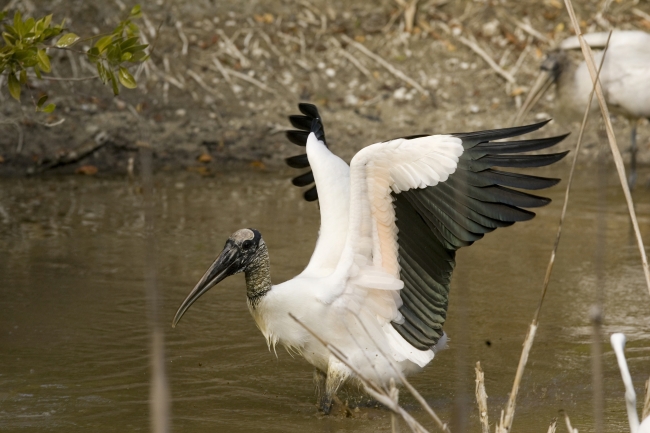
When the wood stork was listed under the Endangered Species Act in 1984, the agency stated it was nearly extinct. As the only stork species that breeds in the United States, its population had plummeted by more than 75 percent over the 50 years prior. The agency states that loss of habitat, primarily in South Florida wetland areas typically used for breeding and foraging, led to the aggressive reduction in population.
The agency now reports that the breeding population is now between 10,000 and 14,000 nesting pairs across roughly 100 colony sites — more than twice the number of nesting pairs and more than three times the number of colonies compared to when the species was listed. Wood storks have adapted to new nesting areas, moving north into coastal salt marshes, flooded rice fields, floodplain forest wetlands and human-created wetlands.
In its final rule filing in the Federal Register, the agency cites studies that state sea level rise is a factor in the decision, stating that as coastal areas become unusable for the birds, other areas may be created that are beneficial to the species.
“While sea level rise is expected to cause the degradation and loss of existing coastal wetland habitats in some areas, marsh migration models also project that new salt marsh habitat will be created as coastal marshes migrate upslope along the coastal upland and water interface, resulting in a net expansion of salt marsh habitat in response to sea level rise in some areas,” the agency wrote.
The proposed rule to delist the bird was filed in 2023 and 35 comments were submitted by the public. As part of its final rule filing, the agency responded to many of the submitted comments.
The Southern Environmental Law Center, an environmental legal advocacy organization, decried the decision, citing the 2023 Sackett v EPA decision as a threat to wetland habitat.
“This is a short-sighted and premature move,” said Ramona McGee, SELC’s Wildlife Program leader. “Wood storks need wetlands to survive, and that habitat is facing overwhelming pressure. This delisting comes at a time when species face a storm of proposed federal rollbacks to habitat protections that are likely to imperil wood storks and countless other Southeastern species.”