
By BLANCHE HARDY
The Lake County Water Authority (LCWA) has initiated a four-year program to address nutrients in Lake Yale. Lake Yale is a 4,041-acre Class III Sovereign Submerged Lands waterbody owned by the State of Florida. The lake is classified as “impaired” for failing to meet state water quality standards. The primary issue is elevated levels of phosphorus, a nutrient that fuels algae growth.
“Phosphorus levels in Lake Yale commonly reach about 500 parts per billion (ppb), with some readings as high as 2,500 ppb.” said Justin Elkins, the LCWA’s Water Resources Director. “When phosphorus levels are that elevated, they can lead to excessive algae growth, poor water clarity and stress on fish and other aquatic life. About 81 percent of the phosphorus entering the lake each year comes from what is known as ‘internal loading.’ That means phosphorus that has built up in the lake’s sediments over time is being released back into the water column.”
The LCWA Board of Trustees voted in 2019 to treat the lake with aluminum sulfate, commonly called alum. FDEP issued Lake Yale Alum and Habitat Restoration a permit last October, approving the proposed restoration work. The program is the first of its kind approved on Sovereign Submerged Lands in Florida. The work is being governed under 63.330, Florida Administrative Code.
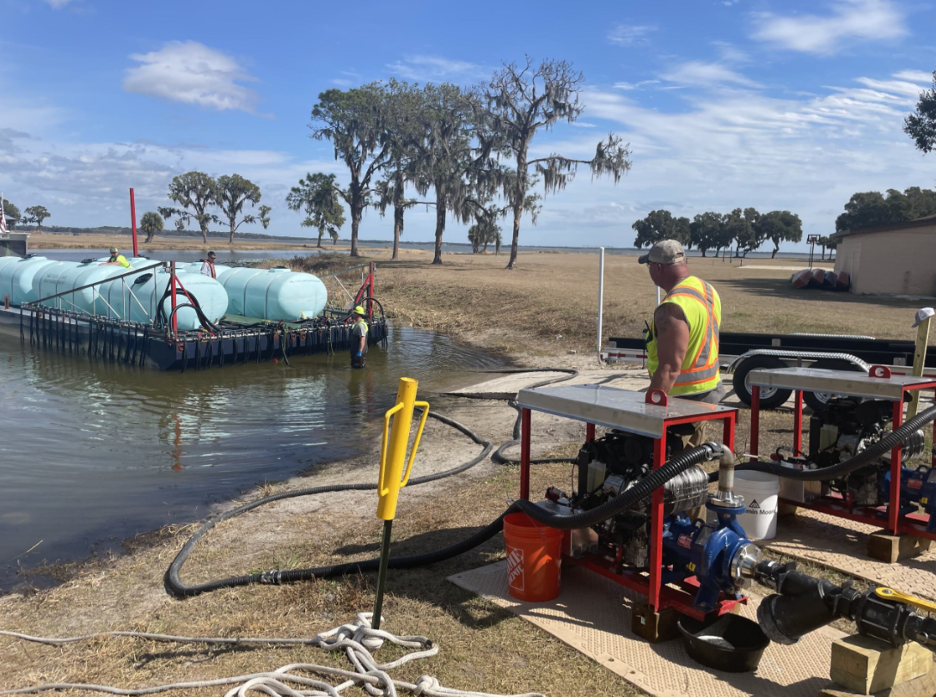
Alum binds with phosphorus in the water and sediments, helping prevent it from fueling future algae growth. The treatment application is planned to take place over four years with continuous monitoring to ensure application rates maintain water quality parameters such as pH, ensuring the health and safety of Lake Yale’s fish and wildlife habitat, water quality, recreational enjoyment, public health and quality of life. For example, pH measurement must fall between 6.3 and 9.0 S.U. to continue application.
“Frequent blue-green algae (harmful algal bloom, or HAB) advisories were a significant factor in the decision to move forward with alum treatment,” Elkins said. “Alum is a widely used and proven method for reducing harmful algal blooms in lakes.”
FDEP’s permit requires the LCWA to submit a pre-alum application baseline monitoring report to the Department detailing the water quality parameters listed in the authorized Water Quality and Sediment Monitoring Project. Initial and subsequent monitoring parameters include pH, Dissolved Oxygen, Alkalinity, Ammonia, Nox, Total Nitrogen, Dissolved Total Nitrogen, Ortho-Phosphorus, Total Phosphorus, Dissolved Total Phosphorus, Turbidity, Total Suspended Solids, Salinity and Chlorophyll a.
In a cooperative meeting between LCWA and UF to discuss the project, scientists from the University of Florida discussed their participation in ongoing monitoring of the program in cooperation with the Eustis Fisheries Research Laboratory, Fish and Wildlife Research Institute and Florida Fish and Wildlife Commission. University researchers plan to assess changes in the ecology of primary producers and consumers, which are important prey for fish and considered effective bioindicators and environmental disturbances.
They propose to perform taxonomic analyses of the algae, benthic macroinvertebrate and zooplankton communities before and after alum treatments. Sampling will center primarily around the second Alum application, planned for the second half of 2026. Samples one week before and after application will be collected for all groups.
The liquid aluminum sulfate (alum) will be applied at an appropriate rate by a barge traversing the lake, reaching all the approved designated treatment areas.
“By reducing the amount of available phosphorus, alum helps decrease the frequency and severity of harmful algal blooms over time,” Elkins said. “While alum is not an instant ‘algae killer,’ improvements in water clarity can often be seen relatively quickly. The full benefits occur over time as nutrient levels stabilize and future blooms are reduced.”