
By DANIELLE IRWIN
Florida has spent years promoting living shorelines as a smarter alternative to hardened seawalls. These projects — using oysters, marsh plants or mangroves — protect property while restoring habitat, improving water quality and strengthening coastal resilience. They are widely supported by scientists, local governments and conservation groups. The Florida Department of Environmental Protection (DEP) highlights these types of projects on its website.
Due to a complex regulatory framework, some of these projects seem to be slowing down or stopping altogether, according to industry experts. This may lead to more hardened construction around Florida’s coastline as professional services firms look for ways to move projects faster so they are maximizing available funding.
According to DEP’s permitting website, as of late February, there were nearly 5,900 pending permits around the state, with more than 800 environmental resource permit requests (ERP) in coastal counties. It’s unclear how many of those are living shoreline projects because those aren’t tracked specifically on DEP’s public-facing website. The Living Shoreline Database on DEP’s website shows no data.
At the center of the challenge is sovereign submerged lands — the lands waterward of the mean high water line that have belonged to the State since 1845 and are held in trust for the public. DEP regulates activities in these areas, acting as the State’s landlord, determining whether projects serve the public interest. Because living shorelines are usually built at or just offshore of the shoreline, they almost always face more scrutiny than seawalls from the outset.
On paper, DEP policy favors living shorelines over seawalls. In practice, the permitting process often tells a different story. Living shoreline projects commonly require additional DEP proprietary authorizations — such as letters of consent, easements or leases — to use state‑owned submerged lands.
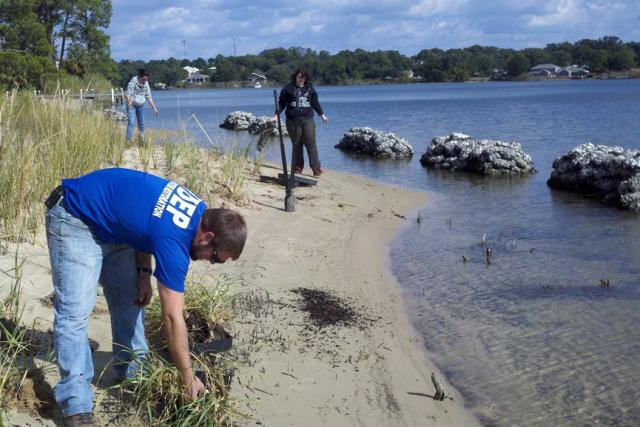
Large living shoreline/nearshore reef projects often have to fight to fit under a DEP Letter of Consent, allowable by Rule 18-21, F.A.C. for habitat restoration, while DEP tries to push the projects into the administratively burdensome lease or easement. Some firms have experienced additional time, cost and uncertainty as DEP decides how to regulate a project, especially for projects that exceed environmental resource permit (ERP) Exemptions. Seawalls, by contrast, are generally faster, cheaper and more predictable to permit.
Applicants are increasingly being asked to conduct detailed studies of shoreline erosion, sediment movement and accretion — analyses that were rarely demanded of similar projects in the past. While these reviews may be defensible under the ERP Rules, in practice they discourage exactly the kinds of nature‑based solutions Florida claims to support.
The strongest disincentive arises when a living shoreline might cause sediment to build up along the shore. In those cases, DEP Division of State Lands may require a boundary line agreement that permanently fixes the pre‑project shoreline through a mean high water line survey and legally binding agreement. Any future accretion — new land created by processes influenced by the project — remains state‑owned.
For property owners, the choice becomes one between investing in a living shoreline and succumbing to the requirements of DEP regulation, or building a seawall to avoid the permit complexities. This has led to predictable outcomes. Grant‑funded public projects have often become delayed, local governments may hesitate and private waterfront owners default to seawalls — not because they are better for Florida’s waters, but because they are easier to permit.
Living shorelines are a tool in the toolbox to solve Florida coastal challenges. As Florida grows and deals with ongoing coastal challenges, its permitting processes and rule procedures may require tweaks to address these complex challenges.