
By STEVE BRAUN, P.E.

For decades, the Mile Marker 35 Rest Area along a stretch of Interstate 75 (I-75) in South Florida, commonly referred to as “Alligator Alley,” has been a place for travelers to stop and stretch their legs and for truck drivers to catch some rest before continuing on their journey across this region of the state.
Today, it is much more.
The Florida Department of Transportation (FDOT) has recently completed its efforts to transform this once-typical rest area site into an immersive Environmental Education Center, a one-of-a-kind destination in Florida where recreation, ecology and transportation come together.
Nestled in the heart of the Florida Everglades, the newly enhanced rest area is surrounded by the Francis S. Taylor Wildlife Management Area and the Miami Canal — a sprawling ecosystem home to many of Florida’s beloved and unique native species.

Once a simple stop for travelers passing through the area, this site has been reimagined into a landmark project for FDOT, offering visitors a chance to learn about one of the state’s most unique ecosystems while enjoying upgraded amenities, including:
- 40-Foot Observation Tower and Multi-Level Boardwalks — Providing sweeping views of the Everglades and close-up encounters with wetland habitats, including wheelchair-accessible ramps.
- Native Plant and Wetland Exhibit — Featuring more than 600 trees, 10,000 shrubs and 17,000 aquatic plants that represent five unique Everglades ecosystems.
- Educational Signs and Exhibits — Informational panels and plant identification markers that highlight wildlife, wetland vegetation, invasive species and FDOT’s role in the preservation of the Everglades ecosystem.
- Reconfigured Parking and Access — Improved truck and car parking, new walking trails and upgraded site utilities to better serve the traveling public.
- Recreation Areas — A new dog park, shaded picnic pavilions and an interactive children’s playground designed with Everglades-themed flooring and educational panels.
With a heightened focus on restoring and maintaining the unique ecology of the Everglades, FDOT engineers and contractors took on a significant challenge to create a living, interactive ecosystem in what was once a truck parking lot through the construction of a three-acre pond exhibit surrounded by wetlands and an arboretum.
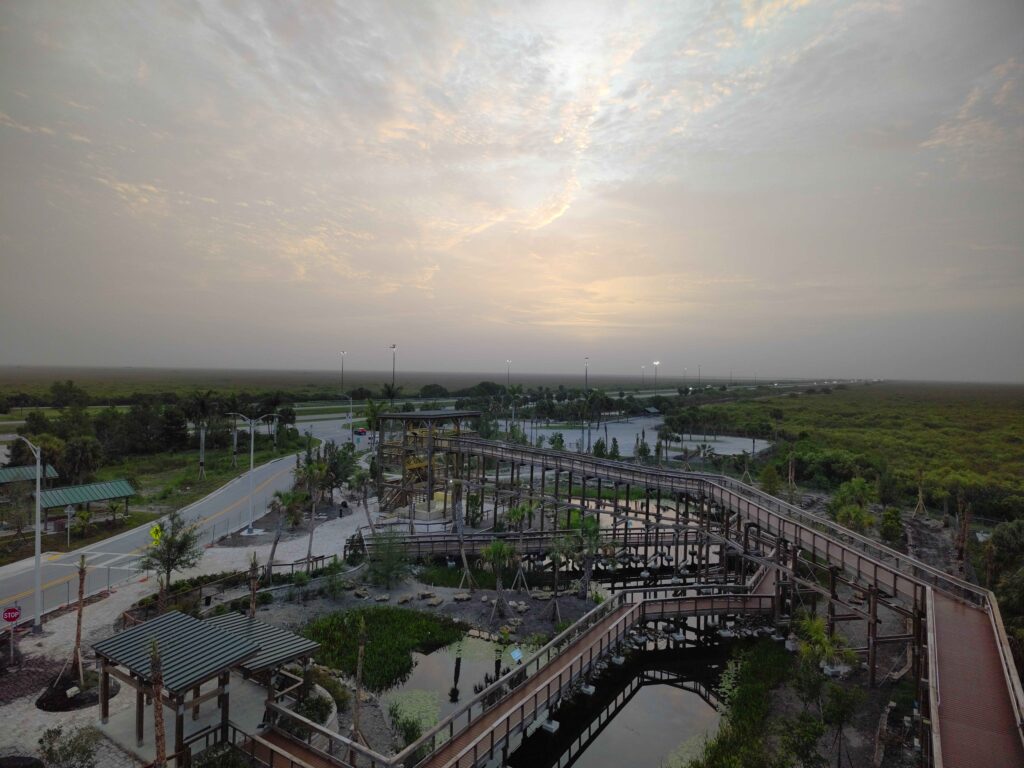
This comprehensive wetland system was engineered to mimic the natural sheet flow of the Everglades and features 13 aquatic species, 68 upland and transitional species and more than 31,000 total plants. In order to bring this vision to life, this complex piece of the overall project involved excavating ponds, dewatering the ground in porous limestone conditions and controlling invasive species. Despite the hurdles, the team was successful in its effort to cultivate an area where native vegetation and wildlife, including young alligators, turtles, and fish, have flourished.
Working with pristine surroundings, FDOT’s design and construction teams took great care to minimize environmental impacts and find creative ways to highlight the natural landscape throughout the project’s design and construction process. These new features were carefully designed to showcase the diverse habitats of the Everglades while creating a safe and engaging space for the public. This project serves as a testament to FDOT’s commitment to blending essential transportation infrastructure with environmental stewardship. It ensures that travelers not only have a safe and comfortable place to stop but also leave with a deeper appreciation of Florida’s irreplaceable natural environment.
This $12.2 million project was delivered in multiple phases beginning in 2016, starting with the installation of educational kiosks and expanding to include large-scale landscaping, drainage improvements and architectural amenities. While the Environmental Education Center officially opened to visitors in August 2025, this project still has additional phases to complete. Future improvements as part of this project will focus on upgrading boat ramps along Alligator Alley to further enhance recreational opportunities while preserving the beauty of the Everglades.
What was once a quick stop for motorists along a greater journey to their destinations, the rest area has in fact become a destination in itself, attracting environmental groups, schools, nature lovers and travelers from across the world. With an average of one thousand visitors exploring the Environmental Education Center each day since its opening in August 2025, the site has proven itself to be a must-visit destination offering a one-of-a-kind opportunity to experience and learn about the Florida Everglades ecosystem.
As we officially enter 2026 and begin the celebration of the 250th anniversary of the United States, it’s worth noting that Everglades National Park was established in 1947 as the first national park created to protect a fragile, living ecosystem, rather than just a scenic geographic feature. This makes the Everglades a perfect example of how Florida’s unique history and natural heritage contribute to the broader American story.
Steve Braun is District Four Secretary of the Florida Department of Transportation