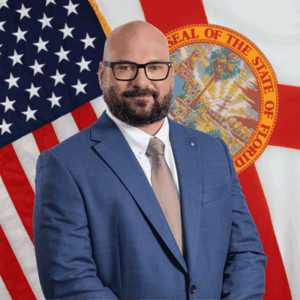
Eddy Bouza was appointed Florida’s Chief Resilience Officer in August 2025, having been with the Florida Department of Environmental Protection for more than four years, with stints at two other state agencies and Collier County government. Bouza previously helped guide local floodplain management efforts at the Florida Division of Emergency Management and he held leadership roles in Collier County government. A certified floodplain manager, Bouza serves on the board of the Florida Floodplain Managers Association and is an active voice in shaping resilience policy statewide.
Bouza answered questions from the Florida Specifier about his past work and his plans for this role:
What’s your background? How did you end up in the resilience world and in this role?
I’m a Tallahassee native and a proud graduate of Florida State University. My path to resilience started in local government, where I saw firsthand how planning and policy decisions shape how communities prepare for and recover from storms. It was there that I became a Certified Floodplain Manager, giving me an on-the-ground understanding of what it takes to get projects in place to protect our communities. I then served with the Florida Division of Emergency Management, helping guide local floodplain management efforts and recovery following multiple tropical cyclones, and advising the Federal Emergency Management Agency on local government activities.
When the Resilient Florida Program was created in 2021, I joined the initial leadership team and have been proud to help build one of the nation’s most forward-thinking resilience programs from the ground up. As Program Management Director for the Florida Department of Environmental Protection’s Resilient Florida Program, I lead a team of about 50 professionals and oversee nearly 700 grants totaling more than $1.5 billion in state-directed investments.
I currently serve on the board of the Florida Floodplain Managers Association, where I continue working to strengthen resilience policy statewide.
Define resilience and how the effort affects Florida?
Resilience is really about the ability to bounce back and recover quickly after a setback. In Florida, that means helping our communities prepare for and withstand flooding, storm surge, hurricanes and other natural disasters so that recovery is faster, safer and less costly.
Our goal is simple: prevent damage where possible, reduce it where we cannot and make sure every dollar invested delivers a meaningful return for taxpayers. By identifying the areas of greatest risk and directing funding to those priorities, we are not only protecting lives and property but also strengthening the foundation of Florida’s economy.
Describe the importance of resilience to this administration.
The DeSantis administration recognized early on that resilience is not just an environmental issue; it is an economic one. A strong, coordinated statewide approach helps safeguard Florida’s communities, infrastructure and natural resources while ensuring taxpayer dollars are used effectively.
Our job is to bring agencies, local governments and researchers together to minimize flood vulnerability across the state. That coordination helps ensure that every project, whether it is a drainage improvement, living shoreline or restored wetland, works in harmony with others and delivers the greatest overall impact.
How is Florida ensuring that state-funded projects are designed to withstand future conditions?
Florida takes a proactive and data-driven approach to building resilience. State law requires a Sea-Level Impact Projection Study for any project that receives state funding, whether it is a new road, fire station or community center. These studies evaluate how future storm impacts could affect project sites and help identify design solutions that reduce vulnerability.
This requirement ensures that state investments are made wisely and that every dollar contributes to stronger, more resilient communities. It is a great example of how Florida is leading by example and embedding resilience into the foundation of public infrastructure planning.
What do you hope to accomplish while you are in this position?
My top priority is to continue aligning the state’s flood resilience and mitigation so that we are maximizing impact and efficiency. That means streamlining coordination between agencies, leveraging federal funding and focusing on projects that deliver measurable benefits.
Ultimately, success to me looks like reduced flood damages, lowered insurance for residents and quicker recovery after storms. These outcomes show that our investments in resilience are paying off for Florida families and businesses.
Are there specific initiatives you have planned?
We are continuing to strengthen coordination across agencies through the Multiagency Mitigation and Resilience Coordination effort. This work helps ensure that time, funding and expertise are all directed toward Florida’s most significant risks and biggest opportunities for return on investment.
A good example is leveraging state dollars to unlock matching federal funds, helping local governments implement mitigation projects at little or no cost. This is smart government at work.
Can you talk about the success so far of the Comprehensive Statewide Flood Vulnerability and Sea Level Rise Data Set and Assessment, and the resulting Statewide Resilience Plan(s), and what you attribute the participation rate to?
The creation of the statewide data set and assessment was a major undertaking that analyzed more than 2.5 million critical assets for their vulnerability to flooding and sea level rise. This work gives us an objective, science-based foundation to prioritize funding where it is needed most.
Since 2021, the Resilient Florida Program has received nearly 1,000 local government project proposals and funded nearly $1.8 billion in resilience work. With local matches, that represents almost a $4 billion investment in just five years.
We have seen tremendous participation from local governments because of strong outreach, collaboration with other agencies, and a clear, consistent process that makes applying for state funding straightforward and rewarding. Continuing with this data-driven, ranked approach ensures that we are funding the highest-priority projects, the ones that deliver the greatest benefit and make the most effective use of taxpayer dollars.
Do you have any plans right now to change processes or operations within the Resilient Florida program?
We are exploring ways to expand rural eligibility for reduced cost-share in the Statewide Resilience Plan. Smaller communities often face unique challenges in funding mitigation projects, so finding ways to make participation more accessible is an important next step.
What’s your vision for Florida’s resilience efforts in the next 5-10 years?
The Resilient Florida Program has become a national model for how states can approach resilience strategically. By the end of next year, all 67 counties, along with a growing number of municipalities, will have completed vulnerability assessments. That means every community will have a clear roadmap to reduce risk and invest wisely.
My vision is a Florida where resilience planning is fully integrated into how we grow and build, where communities see measurable reductions in flood damage and insurance costs, and where every dollar we invest helps safeguard both our environment and our economy.