By CAITLIN BUTLER
The story of the Indian River Lagoon and the Upper St. Johns River Basin (IRL/USJRB) is, in many ways, a story of connection, both natural and created.
For much of Florida’s history, the two systems were naturally separated by the Atlantic Coastal Ridge, but as communities grew and land was drained, primarily for agricultural purposes, canals were cut through the ridge to move water off the landscape more quickly. Over time, those alterations created new connections between the Upper St Johns River Basin and the lagoon, increasing the volume of freshwater, sediments and nutrients into the estuary. Today, those connections continue to influence both the environmental challenges facing the region and the strategies used to restore and protect it.
Over the years, the lagoon has navigated ongoing environmental challenges, from excess altered freshwater flows, nutrients, algae blooms and habitat loss. Now, a different story is beginning to emerge – one centered on restoration, regional coordination and a growing understanding that protecting the lagoon starts several miles west.
The St. Johns River Water Management District (District) recently reached an important milestone through its Basin Management Program with the finalization of the IRL/USJRB Basin Plan.
More than just a planning document, the IRL/USJRB Basin Plan represents years of collaboration among scientists, engineers, local governments, water managers, environmental organizations and community stakeholders working together toward a common goal of improving water quality and restoring the health of both connected systems. The plan also helps align shared restoration priorities and long-term water quality goals within the IRL/USRJB.
That collaborative approach is guiding projects across the watershed, from nutrient reduction and stormwater improvements to large-scale regional initiatives designed to improve the quality and movement of water entering the lagoon, while maintaining essential flood protection.
One of the most important pieces of that effort is diversion projects, which are focused on reestablishing the historical flow of the freshwater back to the St. Johns River.
Throughout the region, these projects are helping redirect nutrient-rich freshwater that historically flowed to the St. Johns River, away from the lagoon, preventing excess runoff from reaching it where it can contribute to algae blooms and degrade water quality. By rerouting flows to treatment areas, storage features or alternative receiving waters, they reduce nutrient loading while also helping maintain healthier salinity conditions within the lagoon. When combined with stormwater improvements, wastewater infrastructure upgrades and habitat restoration efforts, these projects form part of a broader restoration strategy.
The District’s recent completion of the Crane Creek/M-1 Flow Restoration Project is just the latest of many projects implemented to support restoration efforts. The next project, the C-10 Water Management Area project, is currently in the design phase and will redirect another source of freshwater that would otherwise enter the lagoon, treat it and then return it to its natural destination — the St. Johns River, where it can then be used for environmental restoration and possibly an alternative water supply.
At the center of the IRL’s recovery story is seagrass.
Seagrass is the backbone of the lagoon’s ecosystem, providing critical habitat and food sources for fish, shrimp, crabs and iconic species, such as manatees. Healthy seagrass beds also improve water clarity, stabilize sediments and support the overall health of the lagoon’s ecosystem.
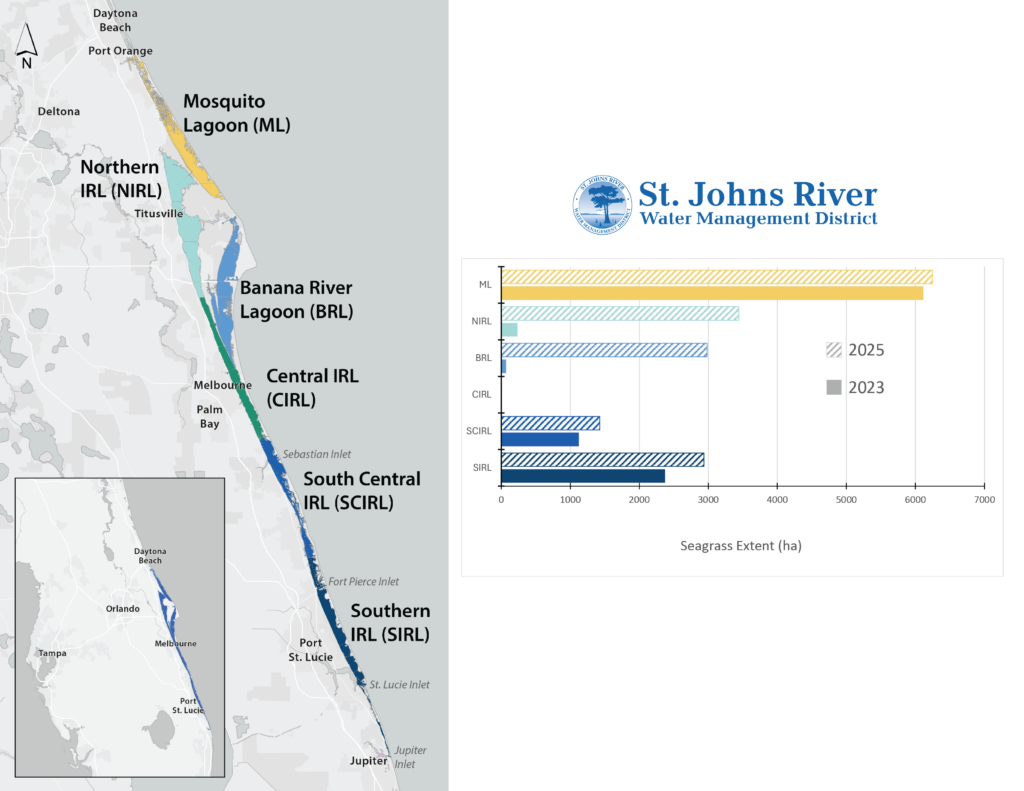
Recent monitoring efforts by the District have provided some of the clearest signs that restoration efforts are beginning to make a difference. Updated seagrass monitoring data released in May by the District document 17,042 hectares of seagrass in the IRL in 2025, an increase of more than 7,000 hectares from 2023 (roughly equivalent to 13,000 football fields).
District staff collect data through biannual aerial mapping and twice-yearly field transects. Using high-resolution aerial imagery paired with in-the-water assessments, scientists can track changes in seagrass coverage, density and distribution throughout the Indian River Lagoon over time. Because seagrass is highly sensitive to environmental conditions, the monitoring data serves as one of the clearest indicators of improving water quality and overall ecosystem health.
Those efforts, and the partnerships behind them, are also highlighted in the recently released “Connected by Water: The Indian River Lagoon” video, which showcases the collaborative restoration work taking place throughout the watershed. Featuring scientists, restoration practitioners, agency leaders, environmental partners and community stakeholders, the video emphasizes how coordinated regional efforts are helping protect and restore the lagoon.
Even recent weather conditions have played a supporting role in the larger restoration picture. Periods of drier weather have temporarily reduced stormwater runoff and nutrient loading entering the lagoon, improving water clarity in some areas and creating conditions that have allowed seagrasses greater opportunity to recover. While restoration depends on long-term projects and sustained investment, these conditions have, in some cases, provided a brief window that supports recovery alongside ongoing restoration work.
Still, restoration partners emphasize that progress is the result of many moving parts working together at once. Strategic planning, scientific monitoring, diversion projects, infrastructure improvements, strong regional partnerships and even variations in rainfall are all helping build momentum toward long-term recovery.
And for the first time in years, that momentum is becoming increasingly visible.
Across portions of the lagoon, clearer water and recovering seagrass beds are beginning to tell a different story; one not solely focused on decline, but on resilience. It is a story shaped by collaboration, guided by science and driven by the understanding that the health of the IRL/USJRB will always be connected by water.
Caitlin Butler is a Regional Media and Communications Coordinator at the St. John’s River Water Management District