By BLANCHE HARDY
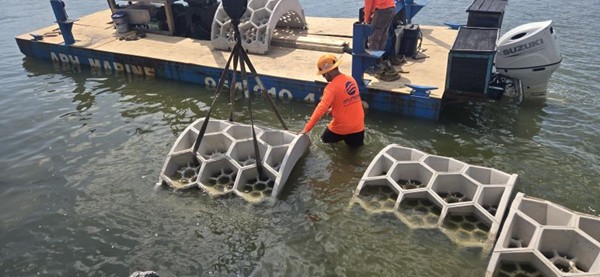
The City of Cape Canaveral has become the first municipality to install Reef Arches — innovative concrete reef structures designed to protect coastlines while enhancing marine habitats. The installation marks a milestone in the city’s ongoing effort to safeguard critical infrastructure along the Banana River Lagoon.
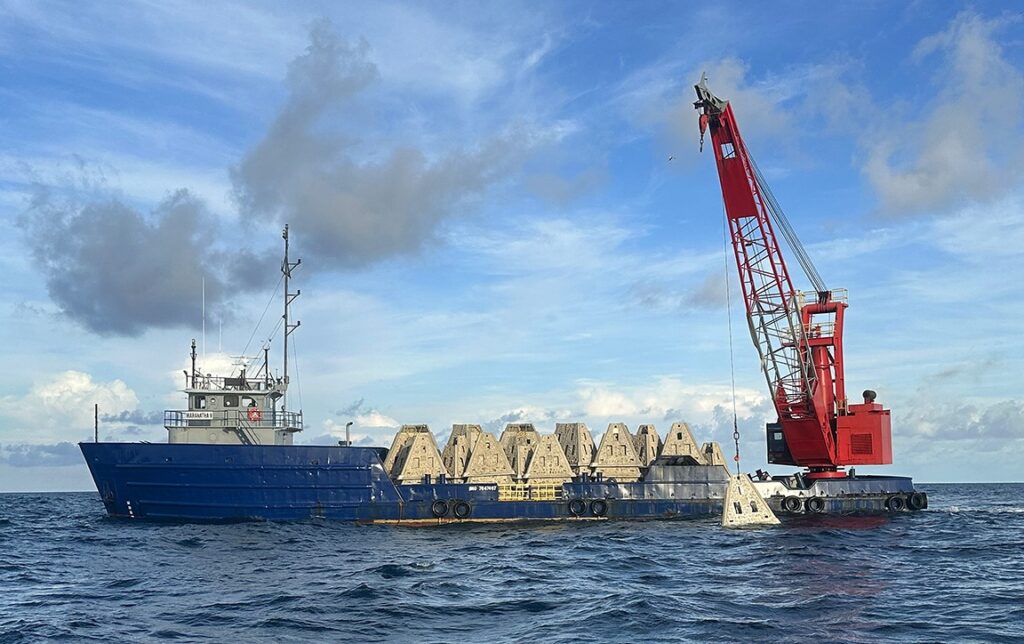
Reef Arches, a South Florida–based company, manufactures modular reef structures intended for both inshore and offshore use. The company’s products are made from a sustainably formulated concrete mix and come in several sizes, including 50-pound and 1,200-pound units, with custom sizes also available. Each unit provides up to 100 square feet of textured surface area within a compact footprint and can be stacked to create scalable breakwater systems.
Cape Canaveral deployed ten 1,200-pound Reef Arch units at the southeast corner of its Water Reclamation Facility, located along the Banana River Lagoon. The site sits adjacent to an oxidation ditch containing roughly 1.4 million gallons of wastewater, an area vulnerable to storm surge and erosion due to its proximity to open water.
Cape Canaveral officials first learned about Reef Arches following a successful 2024 installation by the Marine Resources Council at the organization’s Lagoon House in Palm Bay. That project demonstrated the technology’s effectiveness in both erosion control and habitat creation.
Dr. Mara Skadden, Director of Science at Marine Resources Council, praised both the design and regulatory collaboration.
“MRC permitted this living shoreline project through the Florida Department of Environmental Protection and the U.S. Army Corps of Engineers,” she said. “Both agencies were thrilled with Reef Arches’ design and effectiveness. The Corps even reached out to thank us for using this product and creating new habitat within the Indian River Lagoon.”
The Reef Arches were installed to reduce incoming wave energy while maintaining healthy water circulation. Their open design allows sunlight to penetrate the lagoon floor, encouraging seagrass growth, a key component of the estuary’s ecosystem. Behind the arches, the city reinforced the shoreline with 100 tons of granite boulders and plans to plant mangroves to further stabilize the area.
The installation of Reef Arches and shoreline riprap represents an interim phase in a larger, long-term coastal resilience initiative. The City has partnered with the U.S. Army Corps of Engineers through its Emergency Streambank Protection Program to design permanent shoreline hardening and enhancement measures for the facility. The facility was added to the Corps’ national list of threatened shorelines containing critical infrastructure in 2023.
The Council and Reef Arches have also collaborated on another deployment at Ais Lookout Point, a federally protected archaeological site in Palm Bay that had been severely damaged by hurricanes. In less than a week, the team installed 37 Reef Arch units to stabilize the shoreline and promote sediment buildup.
Within days of deployment at Ais Lookout Point, Council scientists state they recorded several inches of horizontal sediment accumulation and half an inch of vertical sediment accretion — outperforming nearby coquina breakwater systems. The structures quickly attracted wading birds, fish and rays, signaling a thriving new marine habitat.